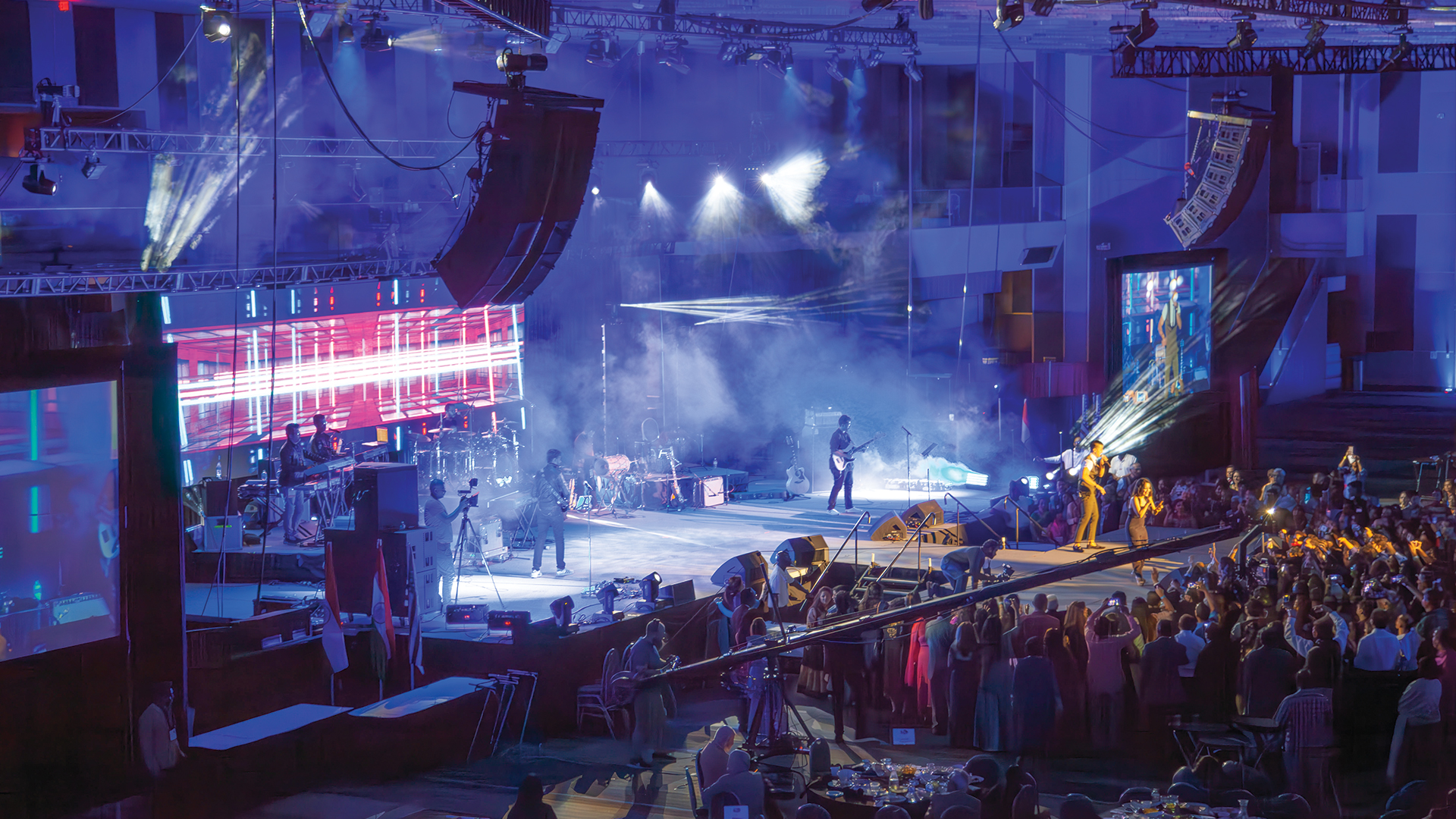
The Geometry of Perfect Coverage: Splay Engineering Across Every Venue Type
The line array is the dominant paradigm in professional sound reinforcement — a column of individually driven loudspeaker elements arrayed vertically to create a coherent cylindrical wavefront that maintains level and frequency response over distances that conventional point source systems cannot match. But the line array is not inherently magical. Its performance depends entirely on the accuracy of vertical splay angles applied between adjacent cabinets — the fractions of a degree that determine whether the array’s energy is precisely distributed across the audience depth or scattered into ceiling surfaces, floor reflections, and the structural geometry of venues that were never designed with acoustics in mind.
Across 600+ venue configurations ranging from 500-seat black box theatres to 80,000-capacity open-air festivals, the optimization of line array tilt and splay represents the single most impactful acoustic decision made during system design. A correctly splayed array covering a raked audience from front to back with plus or minus 2dB of level variation delivers an immersive, even listening experience. An incorrectly splayed array creates hot spots in the front rows, level dropoffs in the rear, and frequency response variations that no amount of outboard equalization can fully correct because they are the product of physics, not electronics.
The Splay Calculation: Constant Curvature vs Progressive Curvature
Line array splay optimization begins with the fundamental choice between constant curvature — identical inter-cabinet angles throughout the hang — and progressive curvature — varying angles that increase from the top of the array (covering distant seats) to the bottom (covering near seats). Constant curvature produces a tight, long-throw system optimized for deep venues, while progressive curvature allows the array to cover both near and far zones with a single hang in venues with extreme depth-to-width ratios.
Acoustic prediction software has transformed splay optimization from an art form dependent on individual engineer experience to a rigorous engineering discipline. L-Acoustics Soundvision, d&b ArrayCalc, Adamson Blueprint AV, and Outline OpenArray each implement proprietary algorithms that optimize splay angles based on venue geometry, audience rake, and target coverage specifications. The engineer defines SPL target (typically 103 to 106dB at mix position), maximum acceptable level variation across the audience (typically plus or minus 2 to 3dB), and the software calculates the optimal splay sequence for the specified cabinet model, hang height, and throw distance.
Venue Archetypes and Their Splay Challenges
Certain venue archetypes present recurring splay challenges that experienced systems engineers have developed standard responses to. Horseshoe-shaped theatres — the classic European opera house geometry — require asymmetric hangs with left and right main systems supplemented by under-balcony fills and front fill arrays to address the severe acoustic shadow created by the balcony overhang. At venues like La Scala in Milan or Royal Albert Hall in London, where modern productions require speech reinforcement and amplified music in spaces built entirely around unamplified acoustic performance, splay optimization must work within rigid constraints imposed by heritage conservation requirements that prohibit permanent rigging infrastructure.
The long narrow arena — common in European hockey venues repurposed for concerts — presents the inverse problem: an audience that extends far in one dimension but is relatively narrow. Main hangs optimized for the near zone over-project into rear walls, creating flutter echoes; hangs optimized for rear throw leave front audiences overexposed. The solution, adopted at venues like Stockholm’s Ericsson Globe (now Avicii Arena) and Amsterdam’s Ziggo Dome, involves split-gradient arrays with the upper elements tightly splayed for long throw and the lower elements more aggressively splayed to cover the downward angle to front-row positions — effectively creating two systems with different splay profiles within a single physical hang.
Festival Stages: The Outdoor Splay Equation
Outdoor festival main stages present the most geometrically complex splay scenarios because audience areas are typically irregularly shaped — wider at the front, tapering toward the sides, with varying audience density across the full field. Modern L-Acoustics K1 and K2 hangs at major festival stages typically employ asymmetric progressive splay configurations with the inner elements (covering the central audience zone) using shallower angles for long throw while outer elements use steeper splay to direct energy downward toward near-field audience areas without excessive coverage of uninhabited ground between the crowd and the PA towers.
The acoustic prediction workflow for a major festival main stage begins with CAD survey data from the site or venue, processed in AutoCAD or Vectorworks before being imported into the audio prediction platform. Engineers model audience density assumptions — typically 2.5 persons per square meter for a sold-out festival — and optimize the splay solution for the specific crowd geometry expected on show day. At events like Primavera Sound in Barcelona or All Points East in London, the splay modeling is conducted weeks in advance, with the finished prediction file shared between the systems engineer, head of sound, and advance production team to validate coverage assumptions before any equipment is ordered.
Real-Time Splay Adjustment and Measurement Validation
Even the most sophisticated acoustic prediction software produces a model, not a guarantee. Real-world splay optimization requires on-site measurement validation using Rational Acoustics Smaart or equivalent tools, with microphone positions covering all major audience zones — front, center, rear, left, right, and balcony positions where applicable. The measurement engineer compares predicted and measured frequency responses at each position, diagnosing deviations that indicate incorrect splay implementation, structural reflections not captured in the prediction model, or rigging geometry differences between the predicted and actual hang position.
The most experienced systems engineers in the industry — practitioners who have optimized arrays across 600+ venues for companies like Clair Global, Solotech, SSE Audio Group, and Wigwam Acoustics — describe splay optimization as a discipline where software expertise and physical intuition must work in parallel. The software identifies the theoretically optimal solution; the engineer’s experience identifies the practical constraints — rigging geometry, venue architecture, available hang points — that determine which theoretical optimum is actually achievable. The 600-venue dataset that experienced touring engineers carry in their professional memory is, ultimately, the most valuable acoustic prediction tool in the industry.
