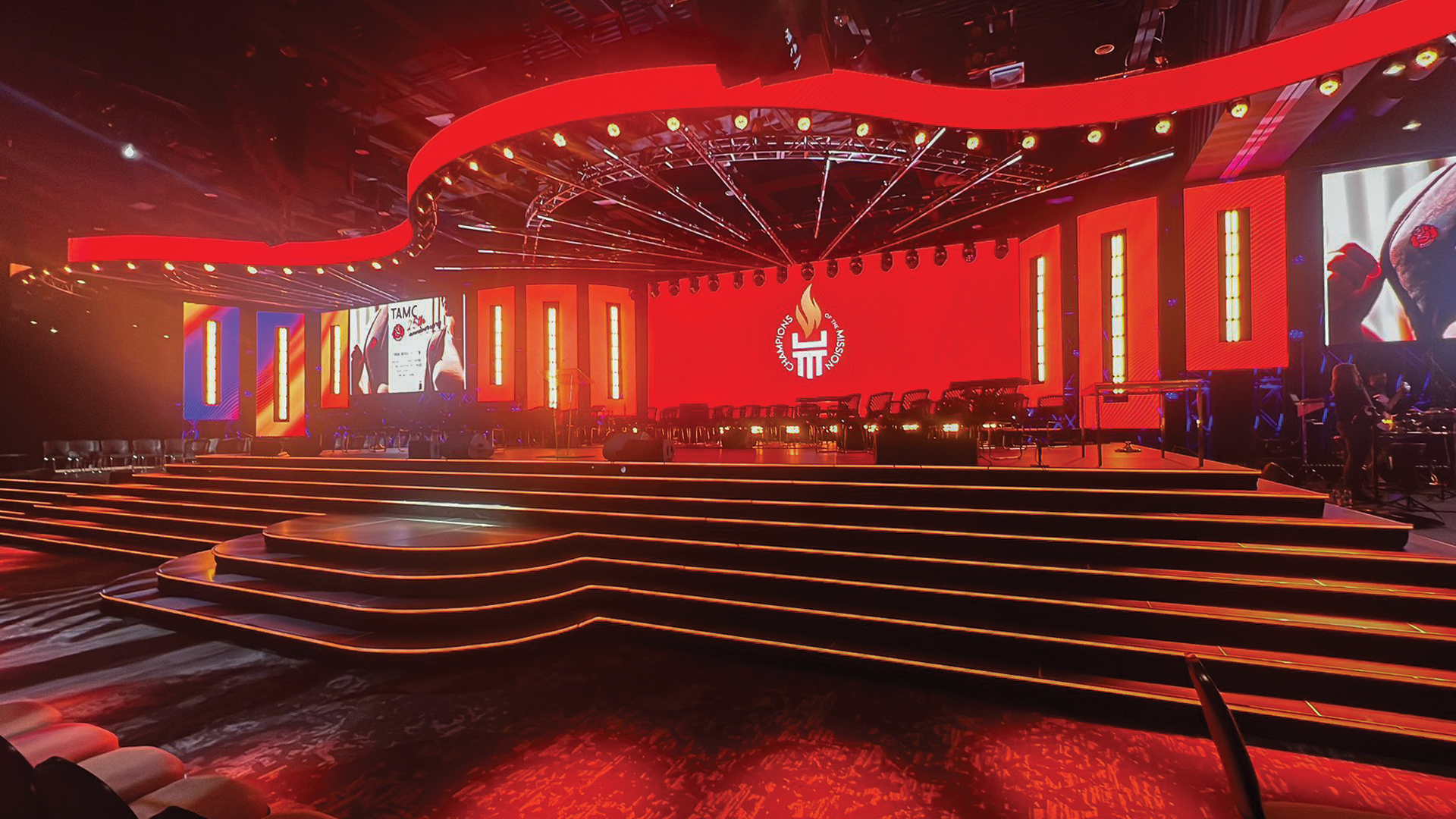
When the Screen Becomes the Stage: LED Walls in the Broadcast-First Era
The convergence of live event production and broadcast television has created a design paradigm unrecognizable to engineers who built The Ed Sullivan Theater in 1927 or even the technicians designing the Oscars stage in the 1980s. In today’s production environment, the LED video wall is not a backdrop for human performers — it is an active creative partner with the multi-camera broadcast system, engineered to deliver content compelling for 20,000 arena attendees and 50 million streaming viewers simultaneously.
This dual mandate has given rise to broadcast-optimized LED mapping — designing, calibrating, and operating LED walls specifically for camera capture. Technical requirements diverge significantly from live audience optimization: refresh rates stable under high-frame-rate cameras, color gamut profiles reproducing accurately in BT.2020 and DCI-P3 color spaces, and luminance levels calibrated against exposure targets rather than ambient venue brightness.
The Refresh Rate Problem and Its Solution
Early LED walls at broadcast events created an immediate technical crisis: cameras operating above 1/500 second shutter speed captured rolling scan lines across the screen — dark horizontal bands created by the LED driver’s PWM dimming cycle scanning faster than the camera shutter. Early American Idol and X Factor productions required camera operators to avoid shooting into LED walls at telephoto focal lengths to prevent contaminating broadcast feeds.
Contemporary broadcast-grade LED panels from ROE Visual, Absen Acclaim Series, and Unilumin Ustorm address this through high-refresh PWM drivers operating at 3,840Hz and above — fast enough to appear flicker-free to cameras shooting at any frame rate in contemporary broadcast production, including 120fps high-frame-rate capture deployed by sports broadcasters. Brompton Technology Tessera processors further enhance broadcast performance through Hydra image processing, dynamically adjusting per-pixel drive current to maintain consistent luminance regardless of content patterns.
disguise and Notch: The Software Backbone of Broadcast Mapping
The creative realization of broadcast LED mapping depends entirely on the media server platform coordinating content delivery. disguise (formerly d3 Technologies) has emerged as the dominant platform for complex broadcast LED environments, with its rx processing units and gx video servers driving pixel-accurate content across LED walls, projection surfaces, and physical scenic elements simultaneously. Productions like The Brit Awards, Eurovision Song Contest, and MTV Video Music Awards rely on disguise infrastructure to coordinate 50+ independent video outputs feeding LED surfaces of different shapes, resolutions, and pixel pitches.
The Notch real-time generative engine — deeply integrated with disguise — enables broadcast productions to generate content reacting to live performance data: audio analysis, timecode, performer position tracked by disguise camera tracking or Vicon motion capture systems. When a performer’s movement triggers corresponding visual changes on the LED wall behind them, Notch provides the computational rendering engine that makes the wall behave as a reactive, intelligent collaborator rather than a passive playback surface.
Calibration Protocols for Broadcast Accuracy
Achieving broadcast-accurate color across large LED walls requires calibration discipline exceeding standards acceptable for live audience viewing. Colorimetric calibration using Klein K-10A or Photo Research PR-740 spectroradiometers establishes white point and gamma profiles aligning the LED wall’s output with ITU-R BT.709 or BT.2020 reference standards. Brompton’s Hydra measurement system automates per-pixel calibration across entire LED walls, correcting luminance and chromaticity variation between panels from different manufacturing batches.
Stage designers working with directors of photography in pre-production now use virtual production previz tools — Unreal Engine with disguise integration, or Epic Games ICVFX workflows — to simulate camera behavior within LED environments before any physical deployment, optimizing wall position, pixel pitch selection, and content design for the specific lenses and apertures of the broadcast camera package.
The ICVFX Frontier
The most dramatic evolution in broadcast LED mapping is the LED volume — a curved or dome-shaped LED wall environment derived from virtual production technology developed for film. Industrial Light and Magic’s Volume built for The Mandalorian demonstrated that LED walls could replace location shoots and traditional green screen for scripted content. Productions using xR (Extended Reality) stages can composite virtual environments behind performers in real-time, creating broadcast images blending physical performance with digital environments. Pharrell Williams’ Grammy performance and numerous award show segments deployed xR stage technology merging live performers with real-time rendered CG environments visible only through the broadcast camera feed.
