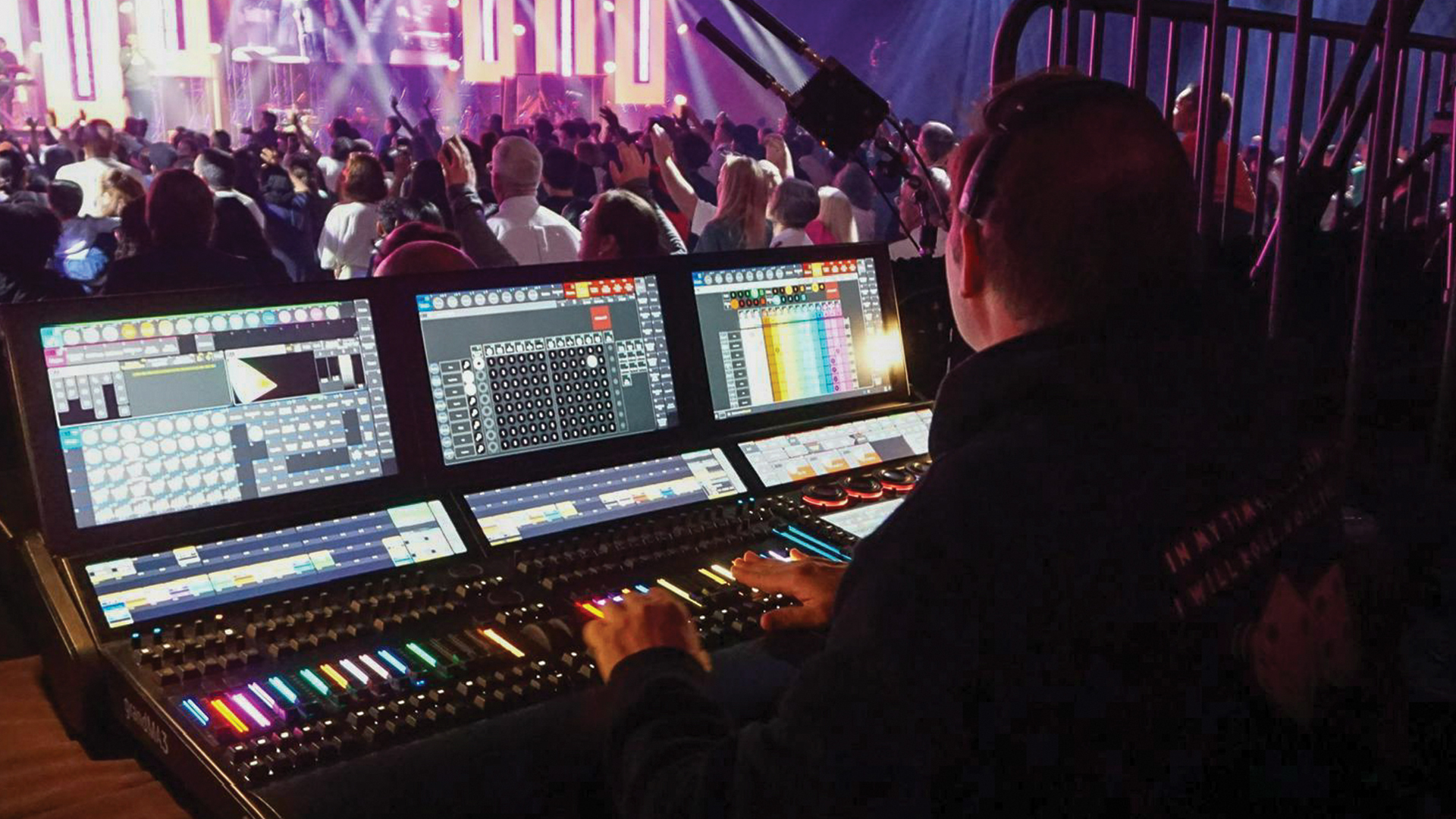
Command, Control, and Chaos: How the GrandMA3 Became the Lighting Brain of Complex Productions
There is no lighting console in the world that has logged more collective hours coordinating multi-stage productions with 3,000+ fixture counts than the MA Lighting GrandMA3. Since its official release in 2018 — following a development cycle that incorporated direct input from LD legends including Patrick Woodroffe, Steve Cohen, and Rob Sinclair — the GrandMA3 has become the de facto command surface for productions that operate beyond the threshold of what any other platform can reliably manage. Its architecture, built around MA-Net3 networking using dedicated 1Gbps and 10Gbps Ethernet infrastructure, supports systems where a single show file coordinates lighting, video, media, and atmospheric effects across stages separated by hundreds of meters.
The competitive landscape that the GrandMA3 dominates is not without challengers. Avolites Titan, Chamsys MagicQ, and ETC Eos platforms each command loyal followings, particularly in theatre and corporate event markets. But in the specific arena of multi-stage festival production — where a head lighting designer might be simultaneously commanding main stage, second stage, and tent stage systems from a single show file distributed across multiple consoles — the GrandMA3’s network session architecture has produced a capability gap that competitors have yet to close.
The Session Architecture That Defines Multi-Stage Control
At the heart of the GrandMA3’s dominance is its multi-user session model. A single MA3 session can accommodate up to 10 full consoles and 10 command wing stations operating simultaneously from a shared show file synchronized in real time across the network. For a production like Tomorrowland in Boom, Belgium — which operates up to 16 simultaneous stages at peak capacity — this means lighting department heads on each stage can program independently while a master LD oversees global cueing and emergency blackout control from the main stage position.
The GrandMA3 full-size console offers 4,096 parameters per executor with hardware processing handling up to 250,000 parameters in real time. Scaling beyond a single console’s native parameter ceiling requires MA-Net processing nodes — the MA3 Processing Unit handles additional parameter loads via network, while the NPU (Network Processing Unit) manages universe distribution across large rigs. At Coachella’s main stage or EDC Las Vegas, rigs routinely exceed 3,000 individually addressed fixtures — moving heads, LED bars, strobes, laser systems, and atmospheric effects all addressed through a single MA3 show file.
Programming Methodology at Massive Scale
Programming 3,000+ fixtures is not merely a matter of having enough console capacity — it requires disciplined show file architecture that prevents a 400-hour programming investment from becoming unmanageable. Experienced GrandMA3 programmers structure large shows around patch group hierarchies, fixture type libraries built from manufacturer-provided GDTF profiles (General Device Type Format), and macro-driven workflows that allow global parameter changes across thousands of fixtures in milliseconds.
The introduction of GDTF (General Device Type Format) and the companion MVR (My Virtual Rig) standard — co-developed by MA Lighting with Robe Lighting and Vectorworks — has partially addressed one of large-show programming’s most persistent headaches: inaccurate fixture profiles. When a Robe BMFL WashBeam or Clay Paky Mythos 2 fixture profile contains incorrect range data, automated programming sequences fail in ways that are invisible during offline pre-programming and catastrophically visible during the first on-site run. GDTF profiles, authored and certified by the fixture manufacturer, have reduced profile-related programming errors at major productions by an estimated 60% compared to user-created DMX profiles.
MA3 in the Broadcast-Critical Environment
When multi-camera broadcast enters the equation — as it does for televised awards shows, New Year’s Eve spectaculars, and major sporting opening ceremonies — the GrandMA3’s timecode integration becomes mission-critical. Productions lock the GrandMA3 to SMPTE LTC timecode fed from the broadcast truck’s master clock, ensuring that lighting cues, video playback from disguise media servers, and live camera tally signals all share the same time reference down to frame-accurate precision
The GrandMA3’s timecode engine supports both SMPTE 30fps and 25fps standards, with the ability to define separate timecode streams for different show sections — critical for broadcast productions that may switch between show timecode during live segments and rehearsal timecode during dress runs without rebuilding the entire cue stack. At Academy Awards ceremonies and Super Bowl halftime productions managed by companies like PRG and Brite Ideas Lighting, the GrandMA3’s timecode reliability under broadcast time pressure has made it effectively irreplaceable.
Historical Lineage: From GrandMA1 to GrandMA3
MA Lighting’s trajectory from a German theatrical lighting company to the global dominant force in large-scale event control is a study in consistent R&D investment. The original GrandMA1 — introduced in 2001 — represented a radical departure from the Strand 500 Series and Avolites Pearl platforms dominating the late 1990s, offering the first truly networked multi-user environment with internal visualization. By the time GrandMA2 launched in 2009, it had achieved the kind of cross-genre dominance that made its name a verb in the industry: productions were ‘GrandMA shows’ regardless of whether the console was actually on-site.
The GrandMA3’s underlying architecture was rebuilt from scratch, abandoning the GrandMA2 codebase entirely — a bold decision that temporarily fractured the user community but positioned the platform for the parameter-count and network complexity demands of productions that would emerge through the 2020s live event boom. Today’s festivals, corporate spectaculars, and broadcast productions operate at scales that would have been considered science fiction during the GrandMA1 era, and the GrandMA3’s headroom — 250,000 parameters per session with network expansion — means it is unlikely to become the ceiling for any real-world production in the near future.
